
American Cocker Spaniel
The American Cocker Spaniel is a smart show dog, an excellent companion, and a gundog. One of the most popular breeds in the world, the energetic and even-tempered Cocker Spaniel gets along well with children, gets along with other animals, and is easily trained. However, it requires regular grooming and isn't always known for its robust health. Origin: USA.

Content
History of origin
Around the 12th century, small hunting dogs began to be imported from Spain to England. They were called spaniels (from the English word "Spain"). They were used to hunt land and waterfowl. Spaniels quickly spread throughout the British Isles and were bred in most European countries. By the early 19th century, numerous varieties existed, differing in working style and appearance, coat type and length, color, and build.
The name of the Cocker Spaniel breed is associated with its specialization - hunting woodcock.
Spaniels arrived in America with the first colonists in the early 17th century. Targeted selection of American Cockers began in the 19th century. Breeders made enormous efforts to "adapt" English Cocker Spaniel to their ideals. The first cocker spaniel was registered in the American Kennel Club's stud book in 1878. In 1881, the first American Cocker Spaniel breed club was established in the United States, and it still exists today. In 1970, it was recognized by the Fédération Cynologique Internationale.
Purpose
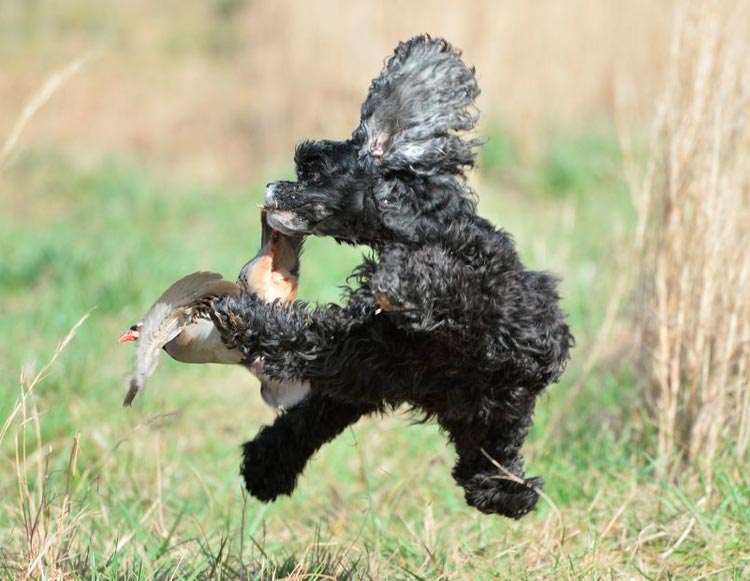
The American Cocker Spaniel, like its English relative, was originally a gundog, but quickly transitioned to companionship. Most members of the breed lack a strong hunting instinct, but they retain a keen sense of smell and are easily trained. This makes them relatively easy to train to hunt game, retrieve, and perform other necessary skills.
American Cocker Spaniels are used in hunting to locate birds, flush them for a shot, and then retrieve and retrieve them. They are trained to hunt marsh, forest, field, and waterfowl.
Cockers can be found in various sporting events (agility, obedience, freestyle). They are used as customs sniffer dogs and in search and rescue operations. In the United States, they are often seen among canine therapists.
Appearance
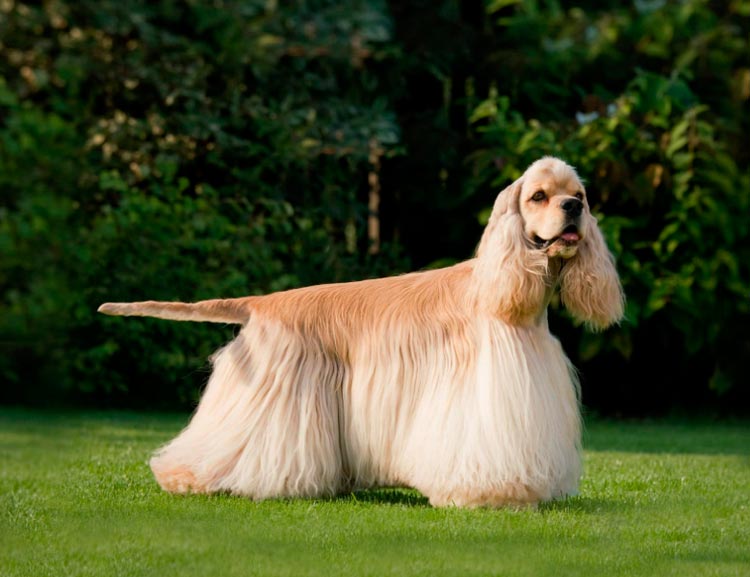
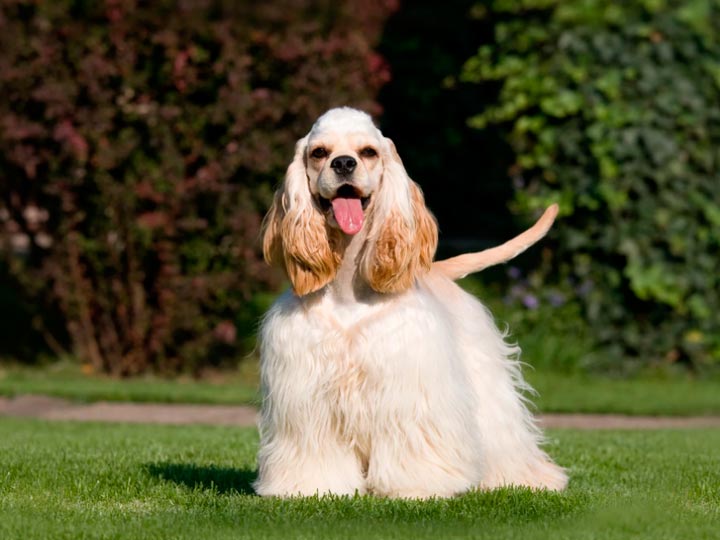
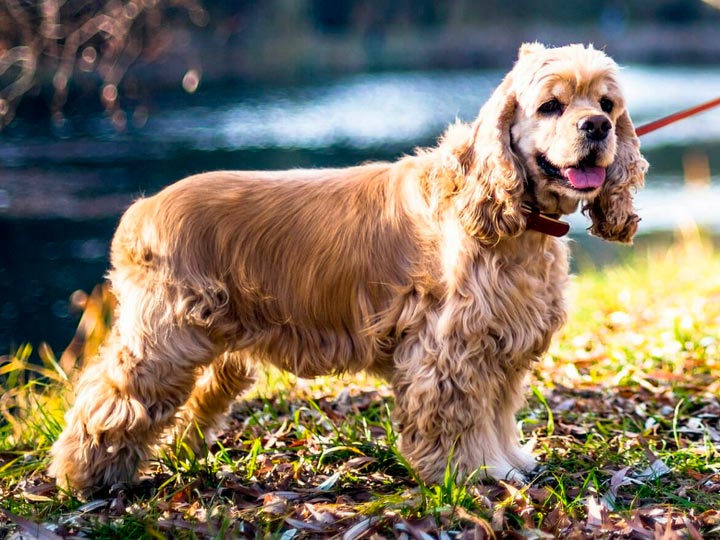
The American Cocker Spaniel is a harmoniously built small dog with a compact, strong body and a noble head. It is the smallest of its group of hunting (gundogs).
- Height at withers: 35-38 cm;
- Weight: about 7.5 kg.
The skull is rounded, with raised superciliary ridges accentuating the sharp stop. The muzzle is deep, broad, and square. Its length is equal to half the length of the skull. The earlobe is large, and the nostrils are wide open. The eyes are round and large, looking forward. The eyelids are almond-shaped. The iris is dark. The ears are long, thin, and lobed, set in line with the eyes. The jaws are strong. The upper lip is tight, overlapping the lower lip. The bite is scissor-like. The long neck allows the dog to easily reach the ground.
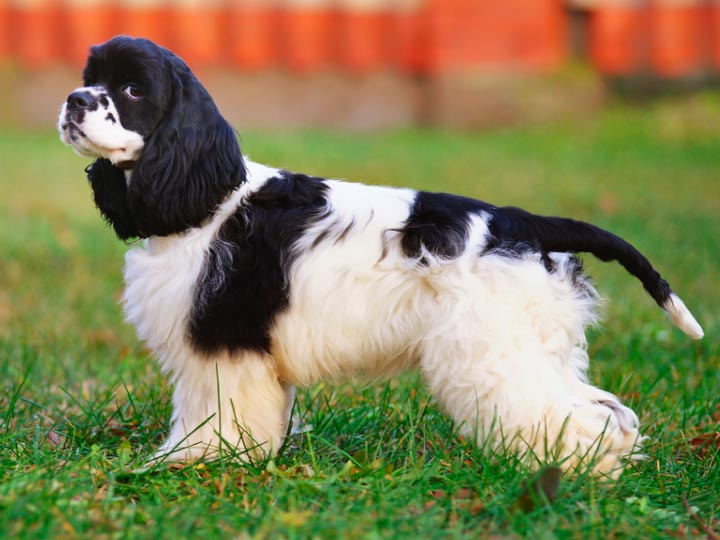
The Cocker Spaniel stands high in front and stands firmly on straight, straight forelegs. The topline slopes downward from the withers to a muscular croup. The chest is deep and broad. The back is straight, strong, and slightly sloping. The tail may be docked and is carried level with the back or slightly higher, and is lively when moving. The shoulder blades are angled at 90 degrees. The elbows are directly under the withers and close to the body. The forelegs are parallel, straight, and have strong bone. The pasterns are short. Dewclaws may be removed. The hindquarters are strong and muscular, with well-angled stifles and strong thighs. The hocks are low. The feet are round, large, and compact. The nails are strong.
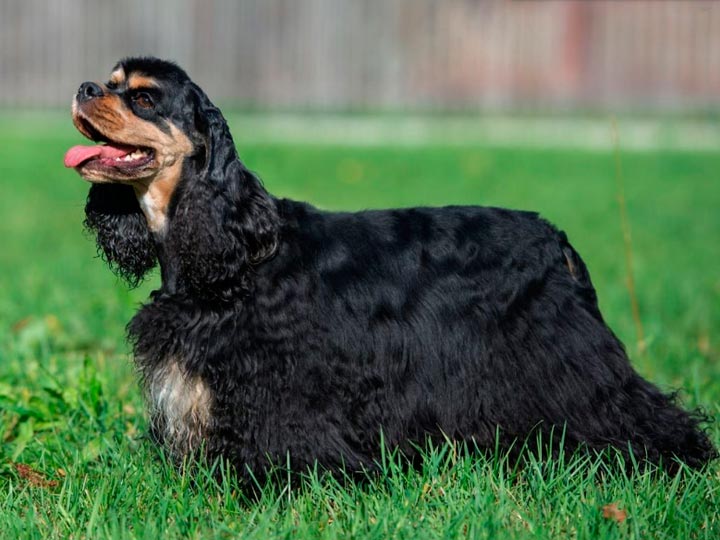
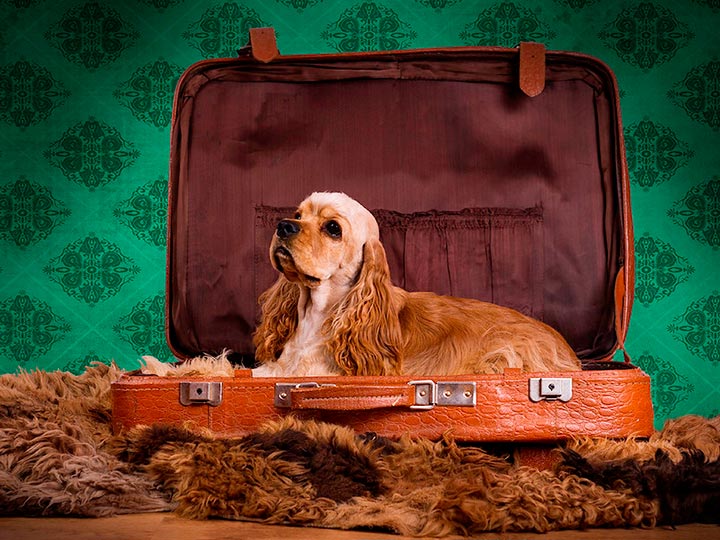
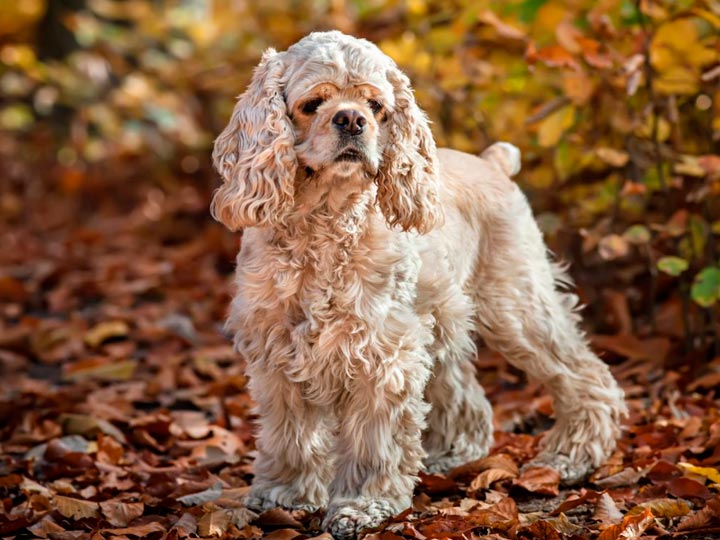
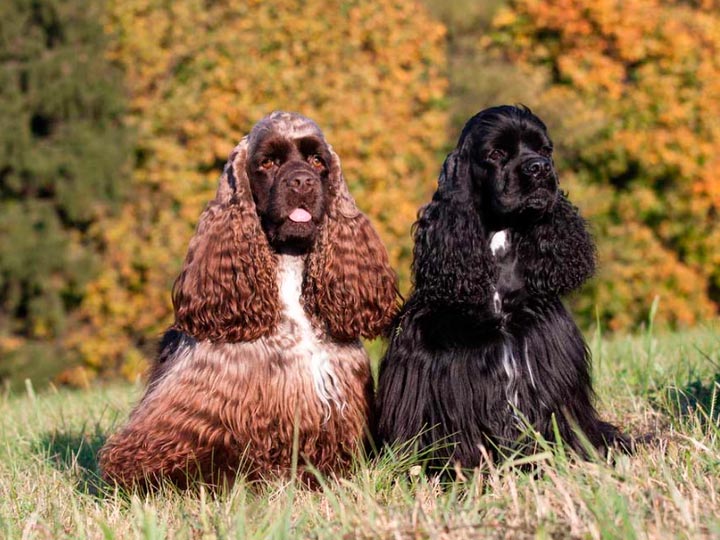
The coat is close-lying, silky, straight or slightly wavy. It is short and soft on the head. It is of medium length on the body. It is longest on the ears, chest, belly, and limbs. The undercoat is well-developed and dense. Colors:
- Solid black or black and tan;
- Any solid color from light cream to rich red, brown, brown and tan inclusive;
- Spotted with or without tan markings (two or more colors with clear boundaries, one of them must be white), as well as roan, any of the colors with tan markings inclusive.
Character and behavior
The American Cocker Spaniel has a balanced character without any signs of cowardice. He is bold, energetic, and active. He is cheerful and friendly among his family. He is always active and playful. He gets along well with children. He can be wary of strangers, but is generally not aggressive. He will always bark to warn of visitors. He is very intelligent and can use cunning to achieve his goals. He quickly learns rules of behavior and easily remembers commands, and is obedient and responsive.
Americans have developed a friendly dog that understands its owner's mood and behaves accordingly. It doesn't pester an irritated person, but will do its best to cheer up the sad and dejected.
The American Cocker Spaniel requires a lot of attention, and its owner is rewarded with responsiveness, sensitivity, and affection. A Cocker Spaniel shouldn't be left alone for long periods of time; it will feel abandoned and become untrusting and unresponsive. Don't worry if you have other pets in the house; the dog will get along well with them, make friends, and enjoy playing.
The Cocker Spaniel is deeply attached to its owner and all household members. While it can be stubborn when obedient, it readily responds to the call to run and play in the yard. It will tirelessly fetch toys and follow its owner anywhere for attention, which can make it seem clingy to some.
People who are busy for long periods of time and inactive may want to consider a different breed.
Training and education
Training a puppy begins the moment it arrives home. Don't wait until it grows up and bad habits become difficult to correct. Reward good behavior, scold misbehavior, and accustom it to daily grooming. Permissiveness can lead to the development of problematic behavior. At the same time, brute force against a puppy is not allowed. Feeling excessive pressure, it loses trust and becomes withdrawn.
It's important to understand that an obedient adult cocker spaniel takes several months of patient and persistent training from a small bundle of energy.
American Cocker Spaniels learn commands quickly and execute them with pleasure. They can learn a variety of tricks, but struggle with tasks that require teeth and paws, such as removing lids or moving cups. While it's easy to teach an adult dog new commands, it's much more difficult to correct undesirable behaviors and habits formed in puppyhood.

Content Features
The American Cocker Spaniel is not suited to living in a kennel or a doghouse. They thrive in apartments and private yards, but prefer to spend most of their time indoors rather than outdoors. If left alone for long periods, they may whine and howl, and sometimes destroy things or bark unprovoked.
The American Cocker Spaniel requires vigorous and consistent exercise, including several hours of walks daily. If this isn't possible, at a minimum, ensure they have ample time to spend active at home. Games and commands like "fetch the slippers" and "find the toy" are excellent activities.
Care
Grooming an American Cocker Spaniel is laborious and expensive, especially if it is a show dog or the owners decide to keep the long coat.
- The coat is combed once every 2-3 days, and daily during the shedding period.
- Bathe your dog every 7-10 days, then comb and blow-dry. After walks, wash their paws and belly frequently. If their fur is thick and long, you'll need to blow-dry it. It dries slowly on its own, and fungus can develop in areas where moisture is retained.
- The ears require special attention. The ear canal is inspected weekly and cleaned as needed. The fur inside is trimmed or plucked. The ears are tied back before feeding, otherwise they will fall completely into the bowl. To keep the ears clean during walks and to protect against burrs, use fabric caps.
- Regular dental brushing is recommended. Some dogs are more prone to tartar buildup. For these dogs, vets may recommend special water additives to prevent plaque buildup.
- Claws are trimmed or filed every 3-4 weeks.
- A dog needs a haircut about every two months. At a minimum, a hygienic haircut is essential. If not, the hair grows long and falls into the eyes (not all dogs), the lower body becomes matted more quickly, and the genital area becomes very dirty.
Owners of dogs that are not shown usually give their pets short haircuts.
American Cocker Spaniels are prepared for shows well in advance. A week beforehand, they are groomed according to the standard. Clipping the coat on the back is not recommended; the hair is plucked to emphasize the natural contours. On the day of the show, they are bathed, blow-dried, and trimmed if necessary. Thus, a dog with a perfectly straight coat at the show may have a wavy coat in everyday life.
Nutrition
The American Cocker Spaniel is not picky about food and is always willing to steal something from the table. They will do anything to get seconds or something tasty. They are prone to obesity. While it's easy to fatten them up, it's much more difficult to regain their weight. The owner chooses their diet. This can include commercial small-breed dog food or homemade food. The diet is based on standard recommendations. Supplements, vitamins, and minerals are given as needed.
Be careful, the cocker's insatiable appetite often leads to obesity, it is very important not to overfeed your pet.
Health and life expectancy
Like many other popular breeds, the American Cocker Spaniel is predisposed to certain health conditions. Some are hereditary, while susceptibility to others is determined by specific anatomical features.
- Deafness;
- Ear infections;
- Dermatological diseases (seborrhea, folliculitis);
- Ophthalmological diseases (progressive retinal atrophy, glaucoma, cataract, cherry eye syndrome, dry eye, entropion, ectropion, districhiasis);
- Hypothyroidism;
- Autoimmune (thyroiditis; hemolytic anemia);
- Diseases of the musculoskeletal system (patella dislocation, hip dysplasia)
- Cardiovascular diseases (dilated cardiomyopathy, sick sinus syndrome);
- Epilepsy;
- Allergy;
- Benign and malignant tumors;
American Cockers often suffer from food allergies and frequently complain of digestive sensitivities. Liver problems may develop in older dogs.
Average life expectancy is 10.5 years. Healthy, well-cared-for dogs can live up to 16 years. According to owners in the UK, US, and Canada, the causes of death were cancer (23%), old age (20%), cardiovascular disease (8%), and autoimmune diseases (8%).
Choosing an American Cocker Spaniel Puppy
Choosing a good breeder is half the battle. They breed healthy dogs with good temperaments and excellent conformation, know a lot about the breed, not just local prices, are always available, and ask the buyer about the living conditions they expect for their puppy. It's important to determine in advance the purchase's purpose, gender, color, and desired age, as well as your time and finances. This approach will minimize the likelihood of buying a problem dog that doesn't fully live up to expectations.
If the dog is not being purchased for show, you can try to find a puppy with a color defect, for example. However, the above conditions must be met. Such puppies are very rare among reputable breeders, but they are always considerably cheaper.
Few American Cockers are used for hunting, and consequently, there are few working lines. If you're looking for a potentially good and versatile hunting dog, other breeds are worth considering. If you're simply looking for a companion who might also be used for duck hunting, a Cocker is a good choice. Working dogs have better hunting instincts, shorter coats, and are somewhat more resilient.
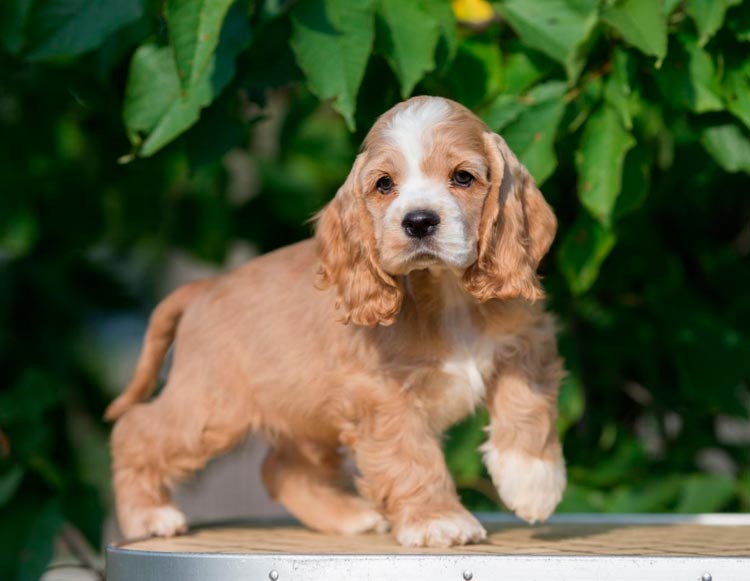
When choosing a puppy from a litter, it's best to trust the breeder or an experienced dog trainer. In good litters, all the puppies are roughly the same size, healthy, well-fed, treated for internal and external parasites, and vaccinated according to age. However, each puppies is born with a different personality and temperament. The first one to approach isn't always the best choice. Typically, this is the bravest, and sometimes even the most feisty, puppy. Such a puppy is best adopted by active young people with experience raising hunting dogs. A puppy with its tail between its legs can be unsafe for children. There's a chance it will grow up overly timid or aggressive. A puppy should be friendly, curious, and trusting. It explores new objects, nuzzles your hands, and soon returns to playing with its littermates. It's recommended to take it to a new home no earlier than two months of age. The baby must have the following documents: birth certificate (exchanged for a pedigree) and a veterinary passport with vaccination records.
Price
A puppy that is not eligible for show can be purchased for around $300. The average price for a purebred puppy is $700. The price is determined by the pedigree, compliance with the standard, the location and quality of the kennel, and other factors.
Photos and videos
The gallery contains more photos of American Cocker Spaniel dogs.




Video about the American Cocker Spaniel dog breed
Read also:


Add a comment