
American Shorthair cat
American Shorthair cat – an aboriginal breed with true feline independence and excellent hunting instincts. Along with the Maine Coon, they are considered a national treasure. The breed is rare and popular only in the United States and Japan. These cats are low-maintenance, hardy, and not very talkative.
Content
History of origin
Native shorthaired cats have been known in America for several centuries. Their ancestors were believed to be European farm cats, which were taken aboard ships to control rats. Upon arriving on the continent, many of them remained ashore with the settlers. For a long time, the American Shorthair breed developed in natural conditions without much human intervention, but in the mid-19th century, when the gold rush swept San Francisco, people remembered these excellent rat-catchers. Fearing the plague carried by rodents, miners paid fifty dollars for a cat, and domestic shorthairs became increasingly common.
In addition to pest control, they helped develop breeds such as the Ocicat, Maine Coon, and Bombay, and later gave rise to the world-famous American Exotic Shorthair, or simply Exotic.
American Shorthairs were first exhibited in Europe at the London Cat Show in 1871, but attracted little attention. Meanwhile, in America, at the 1934 New York Cat Show, an American Shorthair named Mickey took a respectable second place, losing gold to a Persian.
With the arrival of large numbers of imported Persian and Angora cats, the breed lost its former popularity and was on the verge of extinction. They were treated as ordinary stray cats and simply called "domestic shorthairs." Fortunately for the breed, everything changed in 1965, when breeders unanimously voted to change its name to "American Shorthair."
In Russia, the American Shorthair cat breed is not as popular as the British or Scottish Shorthair, but it still has its own club, which is expanding its boundaries every day.
Video review of the American Shorthair cat breed:
Description of the breed
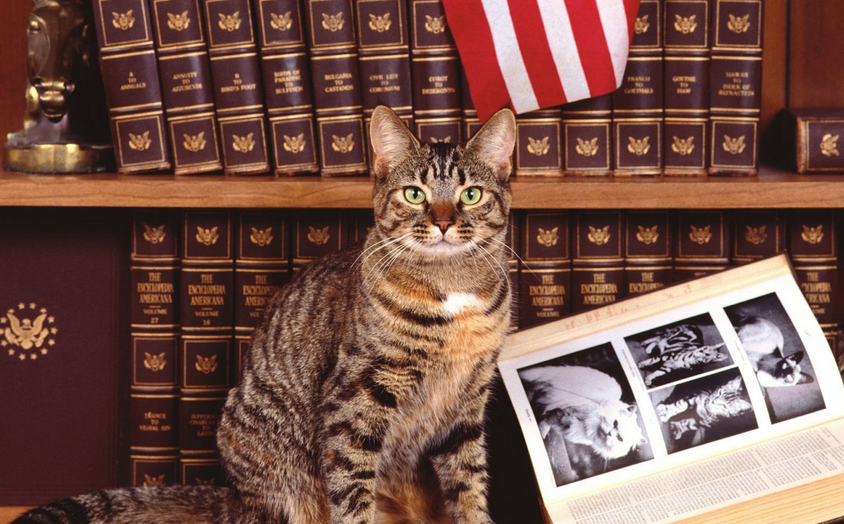
Let's start with a description of the American Shorthair cat: as you can see in the photo, it is medium to large in size, with a powerful, well-built muscular body, well-developed bones, broad shoulders, a capacious chest, and strong jaws.
This is a true working cat, exuding strength and adapting well to any environment. Females weigh on average 4 to 5 kg, while males are slightly larger at 6 to 7 kg. The breed is officially recognized by international feline organizations as the American Shorthair, with the breed description (standard) differing only slightly.
Head and muzzle
The head is large and rounded, with prominent cheeks and whisker pads (especially in males). The muzzle is rectangular and wide. The ears are proportional, medium in size, rounded at the tips and wide and open at the base. They are set close together, the distance between them being twice the distance between the inner corners of the eyes. The forehead is slightly convex. The nose is of equal width along its entire length, with a slight indentation at the stop (the transition from the forehead to the muzzle). The jaws are fairly long and strong.
Frame
The American Shorthair's body is slightly longer (measured from the chest to the croup) than it is tall (measured from the paw pads to the shoulder blades). The neck is muscular and of medium length. The limbs are heavy, muscular, and not too long. Viewed from behind, they are parallel. The paws are heavy, with thick pads, and the toes point forward. The tail is heavy at the base, of normal length, and tapers to a sharply rounded, blunt tip.
Coat and colors
The coat is very thick, dense, and short, with a well-developed undercoat. The guard hairs are shiny and thick, slightly longer than the downy hairs. Any color is possible. Only some colors are considered impure and are not allowed in competitions or breeding: chocolate, fawn, cinnamon, lilac, Tonkinese, and colorpoint.
The European Shorthair and American Shorthair breeds are very similar in their acceptable color palette. They come in a wide variety of colors, including solid, bicolor, tricolor, and tabby. Marbled tabby is the most sought-after and expensive color. Some sources refer to this color as "tabby," which is not a mistake; it's simply a different spelling of the English word "tabby."
.png)
Character
American Shorthairs have a pleasant and easy-going personality. Several centuries of living in harsh natural conditions have left them independent and self-sufficient, yet they are also sociable and affectionate with familiar people. They quickly adapt to the rhythm of family life and are quite intelligent. They dislike excessive attention and are unobtrusive.
American Shorthair kittens are very active and energetic, but even as adults, they retain a love of play and enjoy heights, jumping, and hunting. They prefer to perch in treetops, and indoors on cabinets, bookshelves, and other high perches where they can survey their entire territory. If allowed outdoors, they will certainly delight in catching small rodents, birds, and insects.
American Shorthairs aren't "talkative" or demanding cats; they always have something to say and something to talk about. Often, requests begin with a quiet "meow."
Reviews of the breed
Anyone considering purchasing a kitten of this breed should be aware that they are quite rare and expensive! In the CIS countries, only a few catteries, located in Mokva, Sudak, and Kyiv, breed them.
Pavel Litvinov, a renowned breeder of American Shorthair cats and owner of the STALKER-BARS cattery (Crimea, Sudak), writes about the distinctive features of this rare breed.
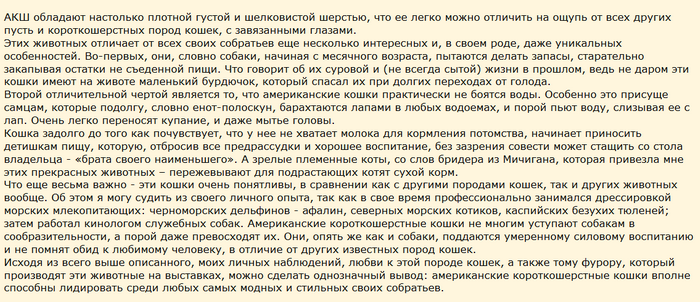
Owners of AKSH kittens share their impressions:
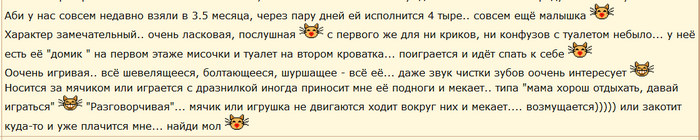

Of course, as cats grow older, they will become calmer, but not so much that they spend the whole day only sleeping and eating.
 Even in adulthood, American women retain an interest in hunting, games, and household chores.

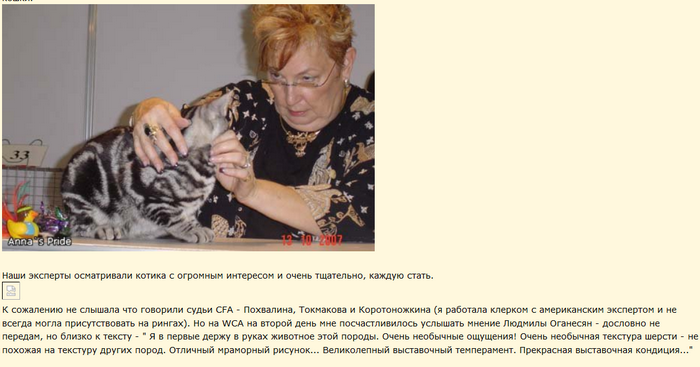
Experts' Opinions on the American Shorthair at the CFA Show
Content
Whether to keep an American Shorthair indoors or with free access to the outdoors is a personal decision. If you decide to let your pet outside, do so only after they've been fully vaccinated and treated for parasites. You should also consider the possibility of unwanted pregnancies in the future and take appropriate measures.
An American cat's home should definitely have plenty of toys. The question of getting their own sleeping area is debatable; many cats prefer to sleep where they like, rather than where someone else has laid their bed.
For busy people looking for a breed that won't get bored when left alone, the American Shorthair is a good choice, with reviews generally positive.
Care and diet
Grooming an American Shorthair involves regular brushing, once or twice a week, and sometimes daily during seasonal shedding periods. Eyes should be washed, ears cleaned, and nails trimmed as needed. Regular bathing is not necessary. If a kitten isn't accustomed to proper grooming from a young age, an adult American Shorthair will inevitably exhibit some unfavorable behavior.
Like any cat, American Shorthairs are recommended to be fed either professional dry and wet food, or natural products. In any case, the pet should receive all the necessary nutrients, vitamins, and microelements. Kittens are fed up to five times a day, three times a day from six months to one year, and adult cats are usually fed twice a day. The amount of food depends on the animal's sex, weight, and physiological condition.
American Shorthairs are prone to overeating, which can lead to obesity and associated health problems.
Diseases
American Shorthair cats are strong and resilient, with a robust constitution and good immunity. However, some lines have a hereditary predisposition to a number of health conditions:
- Hypertrophic cardiomyopathy (hereditary heart disease);
- Hip dysplasia;
- Polycystic kidney disease;
- Non-purulent keratitis Chronic degenerative keratitis (CDK) is found only in American Shorthairs, Siamese, and Persian cats. It is treated exclusively with surgery.
Life expectancy is on average 15-16 years.
.png)
Price and selection of a kitten
Breeders begin listing kittens for sale at various ages, but sometimes they start taking reservations even before they're born. Beforehand, you can attend several cat shows and talk to American Shorthair owners; reviews can help you choose the right cattery.
It's recommended to pick up a kitten no earlier than 12-16 weeks; until then, they need maternal care and interaction with their siblings. At six weeks, the kitten is strong enough to move to a new home, and is usually litter-trained and eating independently.
How much does an American Shorthair cat cost?
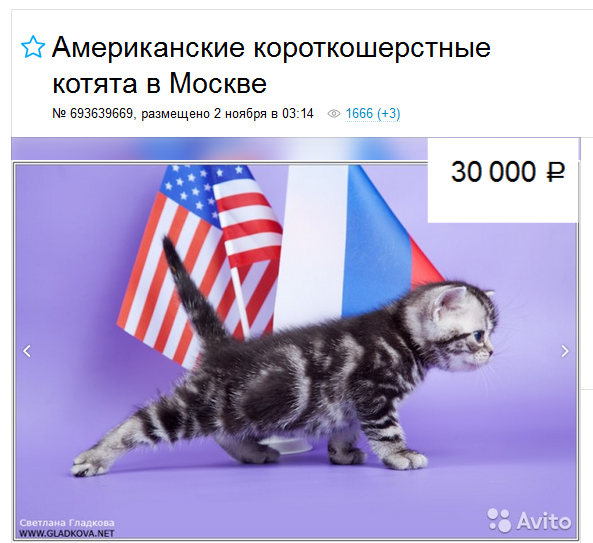
The price depends on the cattery's level, the class of the kittens, and their parents and ranges from $400 to $1,000. The price is also influenced by the kitten's gender; American Shorthairs are slightly more expensive, while males from the same litter may be slightly less. When buying a kitten, keep in mind that small kittens resemble normal kittens, and it's impossible to determine whether a purebred American Shorthair is a true cat from a single photo.
The breeder is required to provide a birth certificate and veterinary passport for the selected kitten. The birth certificate is later exchanged for a pedigree, and the veterinary passport includes vaccination and deworming records.
Photos
Photos of American Shorthair cats:
.png)
.png)
.png)
.png)
Read also:
- American Curl: Cats and Tomcats
- American Bobtail: Males and Females
- Anatolian cat (Turkish Shorthair)


8 comments
Kukumber
We bought a male cat of this breed from DonLeon cattery, Lyudmila Pimenova. Three days later, it turned out the kitten had FIP, which is like AIDS and incurable! It's transmitted sexually and through contact with other cats, meaning the entire cattery is infected (carriers). When I called Lyudmila and told her about the kitten's illness, asking for support and help with contact information for a good vet and advice, Lyudmila started gasping and screaming! She screamed into the phone that she had a bad heart and hung up, never answering my calls again!
Don't buy kittens from Lyudmila Pimenova, the entire cattery is terminally ill!
Dasha is a veterinarian
Hello! Yes, FIV is incurable, but animals live with it (thankfully, humans can't catch it). If you have proof of purchase from her (receipts, sales contract), as well as the health certificate and animal passport (which states the animal has been examined and vaccinated), you could try taking legal action. She sold you a sick animal for the price of a healthy one without warning you about the disease. Only HEALTHY ANIMALS are allowed to breed in catteries (generally, both female and male cats must be tested for infections before mating). If fraud is established, such a "cattery" will be closed. How can you guarantee that she didn't infect the "father" cat with her female cats? It all depends on what you're trying to achieve? Perhaps you should look for other owners who took their animals from her? If all the animals are sick, a class action lawsuit is a possibility.
Patience to you! And may your pet be in good health and free from illness.
Konstantin
Dear Dasha, veterinarian! Where is the guarantee that this message is true? The person could have backed it up with documents (a certificate and purchase agreement for the cat, photos of the diagnosis and test results, etc.) if they truly wanted to warn others. So far, these are just unfounded accusations, reminiscent of eliminating competitors. My daughter and I visited Pimenova yesterday to reserve a cat. Everything is very respectable, clean, and the animals are well-groomed. All documents, vaccinations, etc. are provided. Our cat was born on October 16th, but Lyudmila won't release her until the end of December until she's completed all the necessary training and medical procedures. We haven't requested any tests yet, of course, but I got the impression that this isn't just a business venture for the owner, but rather a love for this breed.
Daria is a veterinarian
That's fine if it's true. If these are unfounded accusations, then such "PR people" should be held accountable for slander. Unfortunately, you can't insert photos in comments. I don't require any proof of the animal's origin; what's important to me is the picture of its illness. If my words have unfairly offended the breeder, I offer my sincere apologies. But my comment is more of a generalization and a call to action for other deceived pet owners, because, unfortunately, there are plenty of unscrupulous breeders, and such "specialists" should be protected from breeding dogs and cats, lest they ruin the breed. For some, it's just business, for others, it's their whole life.
Konstantin
The same comment is posted on other cat sites.
, but under different names. Sounds like black PR? Shame on such competitive methods.
Irina
We have a four-year-old American Shorthair. Buying this breed in Moscow was problematic, and we encountered some unscrupulous breeders, but we finally found one. He loves to sit in your arms, like crazy. He's a real kisser, he'll lick you to death. He loves to climb on top of us when we're sleeping and chatter away, sometimes even putting his paw under our face to make it softer, apparently. He greets everyone and walks with his tail until he gets tired of it. I wouldn't say he's a clumsy cat, especially as he's a working breed, so grace is out of the question. He'll jump up on a chair while turning around, get lost in his surroundings, and then inevitably jump off, catching his paws on the seat as if the height were unimaginable, giving us a nasty look like, "What are you looking at? Can you help me?"
I have a three-legged bed, about 90 cm high, but it doesn't always jump gracefully like in the ads. It bounces, catches itself, and pulls itself up, and the bed falls with the cat in it. It looks graceful, yes. Those shelves with the chandelier—I'm already laughing at how it will look. While I was writing this whole text, the cat jumped into my lap, touched the keyboard, tried to lick it, and started chattering. And when guests come over, for some reason, everyone always gives me the parting words: "Don't hurt the cat, he's so cool." Yeah, he'll make those big eyes that take up half his face, like in "Shrek," and everyone feels obligated to warn him. If you're choosing a breed, don't hesitate to choose an American Shorthair; you'll get a ton of emotions, impressions, and a ton of love. I adore my cat.
Maria
Hello, Irina. Could you tell me which cattery you got your cat from? My daughter is really asking for a kitten, and we're worried about making the wrong choice.
CATHERINE
We got ours from Ekaterina's cattery in Inverness. She's a doctor, and the kittens have a large play area, definitely 40 square meters. There's no smell at all! The kittens are used to everything and aren't even afraid of children. We've been to other catteries as well, but one of them was absolutely terrible. The stench was terrible, all the kittens were dirty and smelly. When you walk into the apartment, the smell was terrible. Of course, you get used to it over time, but I don't think that's normal. I don't remember the name of the cattery. Her name is Lyudmila. When I asked to see her parents and documents, she changed the subject, and she still didn't show anything. The kittens are kept in a cage in her room. She won't let them into the other room, bringing in the dirty and foul-smelling animals separately.
Add a comment