
Chicken allergy in dogs
Chicken allergy in dogs – is there a scientific basis for this concept? Let's explore this issue. Many pet owners consider themselves true veterinary experts. They think they know absolutely everything because they read countless articles and forum posts. But when it comes to actual health issues, these "experts" primarily listen to the advice of forum members (who are also "experts" like themselves) rather than to the recommendations of a veterinarian. Some even read all sorts of myths and believe them to be reality.
The same applies to myths about chicken and dogs. Almost all "miracle specialists," upon noticing allergy symptoms in their pet, are certain that the cause lies in the chicken they fed (or in food containing chicken). But not all of this is true. Let's figure out what's real and what's myth.
Reality or myth?
Let's look at the most common opinions about chicken allergies in dogs and what they might be related to.
The dog started scratching itself, but there are no fleas visible, which means the animal has a food allergy.
In reality, this is not the case. You might not immediately detect the pest that's causing your pet to scratch constantly. Some dogs only need to pick up one flea, but they react as if hundreds of parasites were sucking their blood. Well, that's just how hypersensitive these little whiskers are. Flea and tick collars and drops won't help (or the treatment may have expired, weakening the protection). These pets will also develop a rash (or more accurately, dermatitis) on their skin.
But even if there are no ectoparasites, the appearance of itching and dermatitis can be associated with a host of other reasons.
- These could also be shampoos (you never know what the animal was washed with, some people “sin” by using human cosmetics);
- And medications (allergies to medications are quite often recorded in animals);
- And on household chemicals (the floor was not washed well after using detergents and cleaning products);
- Even animals can be hypersensitive to carpets;
- Houseplants, dust and other allergens can cause your dog to scratch excessively.

And it is absolutely not necessary that a dog’s skin starts to itch because of food.
Dogs shouldn't be fed dry food containing chicken, as it can cause allergies. It's better to choose food containing lamb, beef, or other meats.
In fact, this is a pure myth. Chicken isn't a common food for dogs. Pork, soy, beef, and dairy are much more common. Therefore, any food you initially feed your dog should be given at your own risk. Then, after assessing your pet's reaction, decide whether to feed it. There's no need to be afraid of chicken. Just be careful with high-protein foods. They are almost always allergens. Therefore, your dog's diet should be formulated with its sensitivity to specific foods in mind.
As soon as my dog started eating chicken food, she started itching. It's a chicken allergy.
It's hard to say whether this is a myth or reality. It's a 50/50 chance. Either your dog really is allergic to chicken (which isn't very common), or your pet is hypersensitive to another ingredient in the food (soy, for example). Trying to figure out the cause yourself isn't a good idea. You'll agree that if you eliminate this food, the symptoms may disappear, since the chicken will be the only real allergen in the diet. And you won't be able to determine whether it's the chicken itself that's causing the reaction or something else.
You can switch your pet to a dietary food (one that doesn't contain protein). It's crucial to avoid giving your dog treats or table scraps during this period. Otherwise, you won't know if the itching was caused by the wrong food. Don't expect your pet to stop scratching immediately after stopping the food. It will take some time (some pets "recover" in a couple of days, while others take almost a month).
The most accurate results can be obtained at a reputable veterinary clinic. The veterinarian will conduct an allergy test to determine exactly what your pet is reacting to.
The vet knows nothing. But the online forums are full of experts, and my neighbor had a similar problem.
Every dog is an individualAnd just because your neighbor's dog has been diagnosed with a chicken allergy doesn't mean yours will have one too. Don't rely solely on the word of dog owners. To completely eliminate poultry from your pet's diet, it's a good idea to have test results in hand. Contact your veterinarian. A simple blood test will reveal if your pet currently has any allergies. If one is "detected," allergy testing can be performed to know with absolute certainty what exactly needs to be eliminated from the diet (and perhaps even at home).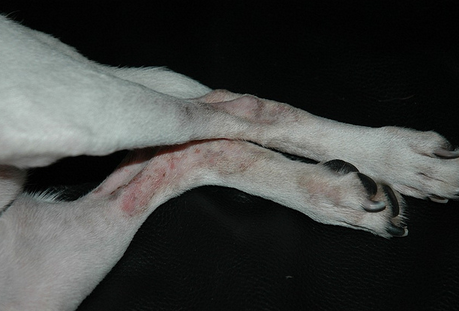
Understand that forums are often populated by ordinary pet owners, not experts. They talk about things they've heard, seen, or read somewhere. It's like a dead end. Much of the information is distorted, and as a result, these "professionals" and "experts" mislead others. It's also important to understand that even within a single breed, there can be those who are allergic to chicken, as well as those who will eat it in any form.
Allergy or...
Some owners confuse the symptoms of other illnesses with allergies. Allergies can be "direct" (from direct contact with an irritant such as food, medications, shampoo, household chemicals, and others) or "indirect" (from another illness). For example, many infectious and parasitic diseases can cause symptoms similar to those of allergies.
It's crucial to initiate appropriate and effective treatment promptly, eliminating the possibility of the animal coming into contact with the irritant. To do this, the irritant must be identified. And this isn't always possible quickly.
Giving allergy medications without determining the cause isn't the answer. While the symptoms will disappear, the immune system will suffer, and the entire body will begin to crumble from the inside. It's impossible to predict the consequences of such therapy for the animal.
Consult a reputable and experienced veterinarian. Only they can figure out what's going on with your pet. Could your dog be allergic to chicken or something else, or could it actually be something else entirely? If necessary, they'll conduct additional tests and develop a dietary plan.
Understand that the advice of "seasoned" and experienced dog owners may not only be inappropriate for your particular case, but may even be harmful to your pet. Just because one veterinarian failed doesn't mean all vets are alike, and you should follow the advice of those who supposedly "succeeded" in curing their dog. Consult a different clinic, ideally one with a lab (so blood samples can be analyzed).
A little about allergies in dogs in general (including food allergies) in the video:
Any questions? You can ask our website's staff veterinarian in the comments below, who will answer them as quickly as possible.
Read also:


5 comments
Tatiana
My dog eats boiled chicken with rice and periodically gets diarrhea. What could this mean?
Daria is a veterinarian
Hello! This could mean a variety of things. It could mean the animal's diet isn't suitable (many pets are intolerant to chicken protein), it could be time for a parasite treatment, or perhaps the dog is getting something else in addition to its regular diet. A change in diet could be the cause of loose stools. This requires further investigation: a complete review of the entire diet, as well as all preventative treatments (deworming, vaccinations).
Elena
A mixed-breed puppy, 3.5 months old. Round bald spots the size of 2 Soviet kopecks have appeared on his paws, a crescent-shaped spot in his armpit, and a spot just above his ear the size of a 1-kopeck coin. The skin is pink and clear, without scales or anything. The dog doesn't scratch them. We noticed these spots a week and a half ago. There are no spots on the dog's belly (I was worried about ringworm). The vet diagnosed a chicken allergy by eye. He didn't order any tests. Our dog eats everything: dry food and homemade food. But mostly homemade food, which contains 30% chicken carcasses. We also give him about 0.3 grams of chicken neck food once a day. Could you please tell me if these chicken parts, even in such quantities, could trigger an allergy (antibiotics are thought to accumulate in chickens, mostly in the muscles, and we're feeding them skeletal parts) and what tests could help us determine the cause of these bald spots? Thank you.
Daria is a veterinarian
Hello! What does 0.3 g mean? Are you just giving them a lick? =) Animals shouldn't be fed bones, especially chicken bones! They're waste that not only clogs the intestines but can also lead to damage to the integrity of the intestinal walls (which leads to peritonitis). The neck also has muscles, for that matter. And they don't give them because of the antibiotics (believe me, store-bought beef and pork contain just as many, they're present there too). There are antibiotics that not only remain in muscle and fat but also deposit in bone tissue (like tetracyclines). Poultry (especially broilers) are often pumped full of hormones to promote growth, but these hormones can lead to skin problems.
If I were you, I'd still ask for a scraping and trichoscopy to rule out fungal infections. If the spots are clearly rounded, it's suspicious (especially on the front paws and head).
X
The article is about chicken allergies, but in fact, the author spends the entire article convincing owners that their dog is not allergic to chicken.
For me, the owner of a dog with an allergy specifically to chicken, the article turned out to be completely useless and empty, a waste of time.
Add a comment